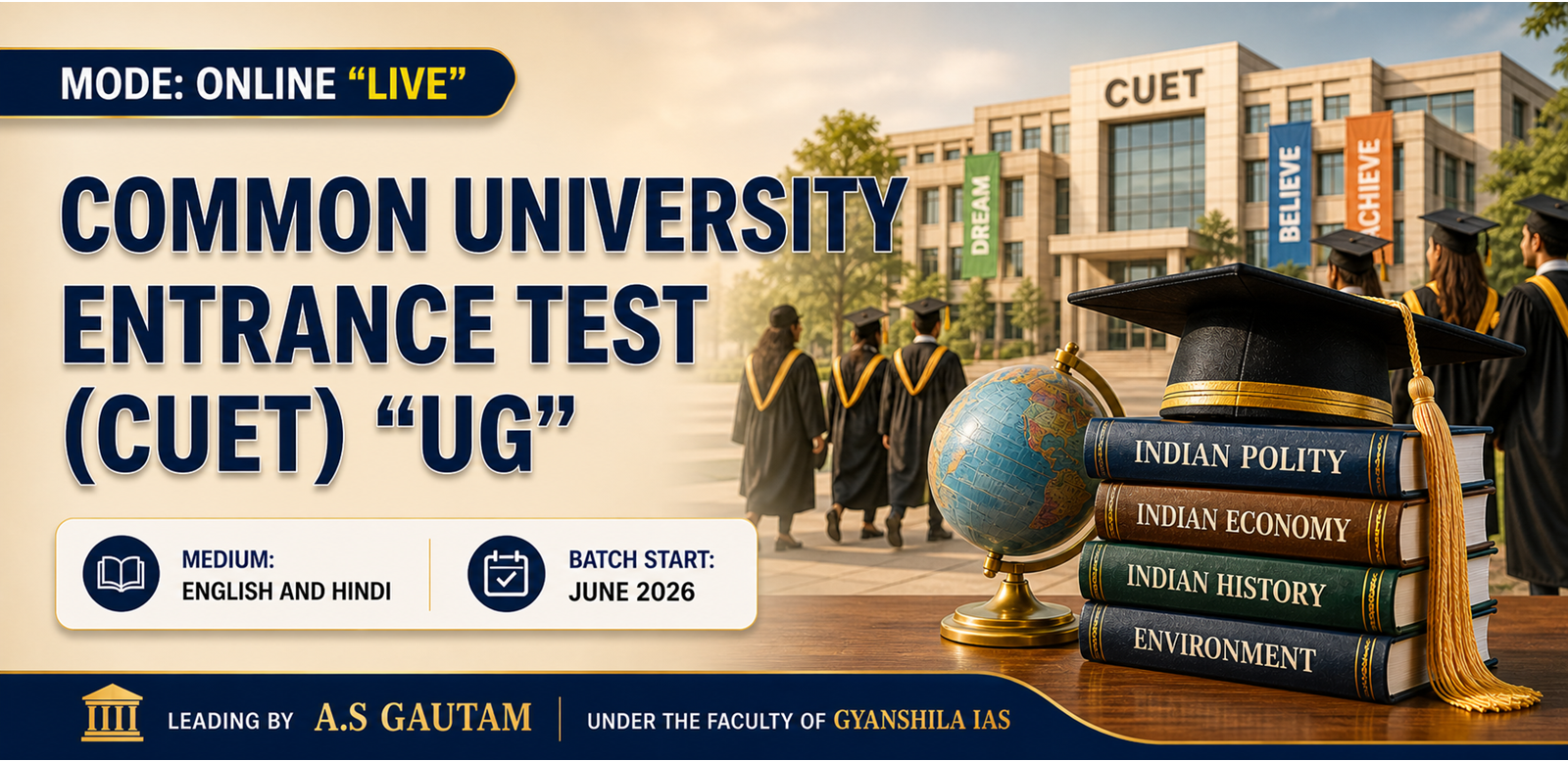
UGC NET/JRF & CUET
CUET "UG" (English - Online)
Classes start
25 Jun 2026
End date
31 Dec 2027
Mode
Online
Maximum seats
800
Sections
2
About this program
Entrance Exam
Study materials
1CUET UG SYLLABUS & OVERVIEW
PDFA structured Batch that strengthens fundamental concepts, covers core subjects comprehensively, and develops analytical for effective exam preparation.
Why Choose Gyanshila IAS?
✅ 10+ Years of Experience Faculty
✅ Smart Teaching through Digital Board
✅ Structured Coverage from Basic to Advanced
✅ Regular Exam Oriented Tests
✅ Doubt Solving & Mentorship Support
✅ Exam-Oriented Study Material
✅ Offline & Online + Recorded Classes Learning Modes
✅ Structured Preparation Strategy
✅ Performance Tracking System
✅ Regular Test Series & Assessments
✅ Revision Sessions and Practice Modules
Course Features:
✔️ Live Classes via Gyanshila IAS App (Android + Apple ios)
✔️ All Section Classes (Basic to Advanced)
✔️ Complete Coverage of all Section (Language, Domain-Subject and GAT)
✔️ 6 Days Weekly Class Schedule (Monday to Saturday)
✔️ Expert Faculty Guidance
✔️ AI-Supported Smart Learning
✔️ Preparation Strategy for Beginners
✔️ Validity: 18 Months
✔️ Course Duration: 7– 8 Months.
✔️ Regular Class Tests for Better Practice.
Study Material Support:
✔️ Printed Books for All Subjects
✔️ Gyanshila IAS Current Affairs Magazine PDF
✔️ Structured Notes & Class Support
Current Affairs Support:
✔️ Regular Current Affairs Classes
✔️ The Hindu Newspaper Analysis
Test & Mentorship Support:
✔️ 50+ Tests on latest Pattern
✔️ Weekly Practice Tests
✔️ Fixed Weekly Lecture Plan.
✔️ One-on-One Mentorship Support
✔️ Current Affairs PDFs Provided Regularly.
CUET UG Exam Pattern & Syllabus
The Common University Entrance Test (CUET-UG) is conducted by the National Testing Agency (NTA) for admission to undergraduate programs in central, state, deemed, and participating universities across India. The exam is conducted in Computer-Based Test (CBT) mode and consists entirely of Multiple Choice Questions (MCQs).
The Structure of CUET UG
CUET UG is broadly divided into three categories of tests:
1. Language Test
This section evaluates a candidate's language proficiency.
It generally tests:
- Reading Comprehension
- Vocabulary
- Grammar
- Verbal Ability
- Synonyms and Antonyms
- Rearrangement of Sentences
- Language Usage
Available languages include:
- English
- Hindi
- Assamese
- Bengali
- Gujarati
- Kannada
- Malayalam
- Marathi
- Odia
- Punjabi
- Tamil
- Telugu
- Urdu
Each language paper generally contains 50 MCQs and is conducted for 60 minutes.
2. Domain-Specific Subjects
These are the core academic subjects.
Examples include:
Science Subjects
- Physics
- Chemistry
- Biology
- Mathematics
- Computer Science
- Environmental Science
Commerce Subjects
- Accountancy
- Economics
- Business Studies
Humanities Subjects
- History
- Political Science
- Geography
- Psychology
- Sociology
- Philosophy
- Home Science
- Fine Arts
- Physical Education
and several others...
Question Pattern
For every domain subject:
- 50 MCQs
- All questions compulsory
- Duration: 60 minutes
- Maximum Marks: 250
The syllabus is primarily based on NCERT Class 12 curriculum.
3. General Aptitude Test (GAT)
This section is required by many universities and courses such as:
- BBA
- Management Programs
- Integrated Law Courses
- Hospitality Programs
- Various multidisciplinary programs
Topics include:
Quantitative Aptitude
- Percentages
- Profit & Loss
- Ratio
- Average
- Time & Work
- Simple Interest
Logical Reasoning
- Coding-Decoding
- Series
- Blood Relations
- Direction Sense
- Statement-Based Questions
General Knowledge
- Indian Polity
- History
- Geography
- Economy
Current Affairs
- National Events
- International Events
- Government Schemes
- Sports
- Awards
General Mental Ability
- Analytical Thinking
- Decision Making
- Pattern Recognition
The GAT paper usually contains:
- 50 MCQs
- 60 minutes duration
- Maximum 250 marks
Marking Scheme
The marking scheme is straightforward:
Correct Answer: +5 Marks
Wrong Answer: −1 Mark
Unattempted Question: 0 Marks
There is negative marking, so random guessing can reduce your score.
CUET UG Syllabus
SECTION A: Language Test Syllabus
The syllabus is similar for all languages.
Reading Comprehension
Questions may be based on:
- Factual passages
- Literary passages
- Narrative passages
- Editorial-type passages
Skills tested:
- Main idea identification
- Inference making
- Tone of author
- Vocabulary in context
- Logical conclusions
Vocabulary
Topics include:
- Synonyms
- Antonyms
- One-word substitution
- Idioms and phrases
- Word meanings
- Contextual vocabulary
Grammar
Topics include:
- Parts of Speech
- Tenses
- Subject-Verb Agreement
- Articles
- Prepositions
- Conjunctions
- Active-Passive Voice
- Direct-Indirect Speech
- Error Detection
- Sentence Improvement
Verbal Ability
Topics include:
- Para-jumbles
- Sentence Rearrangement
- Fill in the Blanks
- Cloze Test
- Sentence Completion
SECTION B: Domain Subject Syllabus
The syllabus is mainly based on Class 12 NCERT curriculum.
Science Stream
Physics
Major Units:
- Electrostatics
- Current Electricity
- Magnetic Effects of Current
- Electromagnetic Induction
- Alternating Current
- Optics
- Dual Nature of Matter
- Atoms and Nuclei
- Semiconductor Electronics
Chemistry
Physical Chemistry
- Solutions
- Electrochemistry
- Chemical Kinetics
- Surface Chemistry
Organic Chemistry
- Haloalkanes
- Alcohols
- Phenols
- Ethers
- Aldehydes
- Ketones
- Carboxylic Acids
- Amines
- Biomolecules
Inorganic Chemistry
- d-Block Elements
- f-Block Elements
- Coordination Compounds
- Metallurgy
Biology
Botany
- Reproduction in Plants
- Genetics
- Biotechnology
- Ecology
Zoology
- Human Reproduction
- Evolution
- Human Health and Disease
- Biotechnology Applications
Mathematics
Algebra
- Matrices
- Determinants
Calculus
- Continuity
- Differentiability
- Applications of Derivatives
- Integrals
- Differential Equations
Vectors and 3D Geometry
Probability
Linear Programming
Commerce Stream
Accountancy
Topics:
- Partnership Accounts
- Company Accounts
- Financial Statements
- Cash Flow Statement
- Ratio Analysis
Business Studies
Topics:
- Principles of Management
- Planning
- Organising
- Staffing
- Directing
- Controlling
- Marketing
- Consumer Protection
Economics
Macro Economics
- National Income
- Money and Banking
- Government Budget
- Balance of Payments
Indian Economic Development
- Indian Economy
- Economic Reforms
- Human Capital Formation
- Rural Development
- Employment
Humanities Stream
History
Themes:
- Harappan Civilization
- Mauryan Empire
- Mughal Period
- Colonial India
- Freedom Struggle
- Post-Independence India
Political Science
Topics:
- Cold War
- Globalization
- Indian Politics
- Constitution
- Parliament
- Judiciary
- Federalism
Geography
Human Geography
- Population
- Migration
- Human Development
India Geography
- Resources
- Agriculture
- Industry
- Planning
Sociology
Topics:
- Social Institutions
- Social Change
- Globalisation
- Indian Society
- Cultural Diversity
Psychology
Topics:
- Intelligence
- Personality
- Psychological Disorders
- Attitude
- Social Influence
- Stress Management
SECTION C: General Aptitude Test (GAT) Syllabus
General Knowledge
Topics:
- Indian History
- Geography
- Polity
- Economy
- Science
- Environment
Current Affairs
Focus Areas:
- National Events
- International Events
- Government Schemes
- Awards
- Sports
- Important Reports
Quantitative Aptitude
Topics:
- Number System
- Percentage
- Profit and Loss
- Ratio and Proportion
- Average
- Time and Work
- Time and Distance
- Simple Interest
- Compound Interest
- Data Interpretation
Logical Reasoning
Topics:
- Coding-Decoding
- Blood Relations
- Direction Sense
- Syllogism
- Series
- Analogies
- Statement and Conclusion
- Seating Arrangement
Analytical Reasoning
Topics:
- Puzzle Based Questions
- Data Analysis
- Critical Thinking
- Decision Making
List of Major CUET UG Subjects
The major subjects available under CUET include:
- English
- Hindi
- Accountancy
- Agriculture
- Anthropology
- Biology
- Business Studies
- Chemistry
- Computer Science
- Economics
- Environmental Science
- Fine Arts
- Geography
- History
- Home Science
- Mathematics
- Mass Media
- Physical Education
- Physics
- Political Science
- Psychology
- Sociology
- Sanskrit
- General Aptitude Test (GAT) and others.
Course highlights
1Comprehensive coverage of CUET (UG) syllabus as per latest exam pattern + Concept Building + NCERT Foundation + PYQ Practice + Mock Tests + Revision Sessions.
6 Days a week · 18 Months
Related courses
View all
UGC NET JRF (English - Online)

UGC NET JRF (Hindi - Online)

UGC NET JRF (English - Offline)